

Forums › Knowledge Base › Debugging Two-stage Flight at MHM – The Twins
- This topic has 38 replies, 12 voices, and was last updated 17 years, 4 months ago by
 slipstick.
 slipstick.
-
AuthorPosts
-
2008-05-06 at 8:15 pm #40254
 slipstick
ROOT CAUSE FOUND – See my post on 2nd page
I could use a little help from folks (especially those who have actually done HP staging) in doing a post-mortem and brainstorming a bit on my my two-stage flight at MHM. The flight appeared to be succesful (see pictures in the following post) and all electronic functions (4 avbays with backup systems) and charges worked as planned, however the sustainer came back without the fin can section, which included the motor hardware and ignition avabay. The 15 foot long 1/4″ tubular kevlar cord from Giant leap snapped at the simple slip-knot loop for the sustainer drogue chute. It was located about 2-1/2 feet from the altimeter avbay. The quick link was missing along with the drogue. Its obvious that the deployment of the drogue was premature and at high speed, however, the question for this forum is…. WHY did it occur? The goal here is to have a good scientific or otherwise reasonable explanation of what occured and to not repeat the occurance in the future.
Note: the sustainer’s RRC2X read 5818 feet ❓ and the RRC2-mini was accidently reset in trying to read its memory as it only read 319 feet. These readings are not even in the ball park of the altitude it should have achieved. The booster’s Adept Alt25K read 2800 feet for the booster’ s apogee. It is possible that the rocket never got higher because of the separation, but many onlookers with experienced eyes said the rocket trail went much higher than what was indicated. Rocksim calculated the burn of the booster stage (Ricky) to stop at 2200 feet and the upper stage (Micky) to stop at 7000 feet. The Twins were supposed to achieve over 14,000 ft. FYI, this rocket was named after myself and my twin sister.
I obviously do not appreciate or understand totally the drag separation forces involved, as I keep encountering this issue as I make more powerful and complex rockets. Hopefully, if the fincan is recovered it will provide more data.
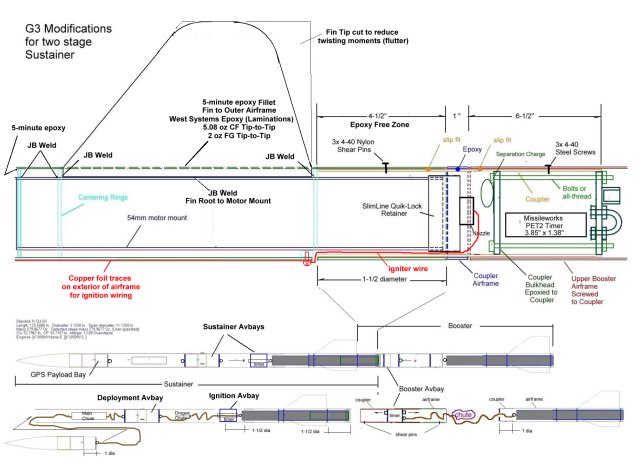
This was my 1st two stage HP rocket which was an evolutionary project based on two Performance Rocketry G3 kits. It started as my L2 Cert bird and grew to include another stage. Another design permutation (next month) will have a boosted dart. The construction assembly is pictured below (the drogue shock cord broke between the igniter avbay and the deployment avbay):

Full size PDF:
http://www.telerover.com/rockets/MS/G3_mods_two-stage_Rev8.pdfPossible failures of the shock cord and/or premature separation:
1- Shock cord length not long enough? 15 foot was used, 20 feet is now available. I used 40 feet on my L3.
2- Shock cord diameter not sized correctly? The choice was 1/4″ or 1/2″ from Giant leap. A 3/8″ option would have been nice.
3- Inadequant pressure venting of the airframe? a 2mm (.080″) hole was at the end of each tube, but I may have covered one with vinyl. The internal pressure could have ben added to the drag separation forces.
4- Inadequate static vent holes in altimeter bay, causing premature deployment? There were three 1/8″ dia holes in the 3″ x 9″ long avbay.
5- Insufficient mach delay time? I programmed in 12 seconds on both the RRC2X and RRC2 mini. The rocksim maximum velocity was Mach 1.2.
6- Too small of shear pins? I used 3 equal spaced 4-40 nylon screws. In its one stage configuration 2-56 screws were used.
7- Should have used accelerometer based controllers rather than barometric sensor based controllers?
8- Your thoughts? 💡
I’ve ordered parts to build it again so i can get it right next time. Failure is not an option.
2008-05-06 at 8:45 pm #47835slipstick
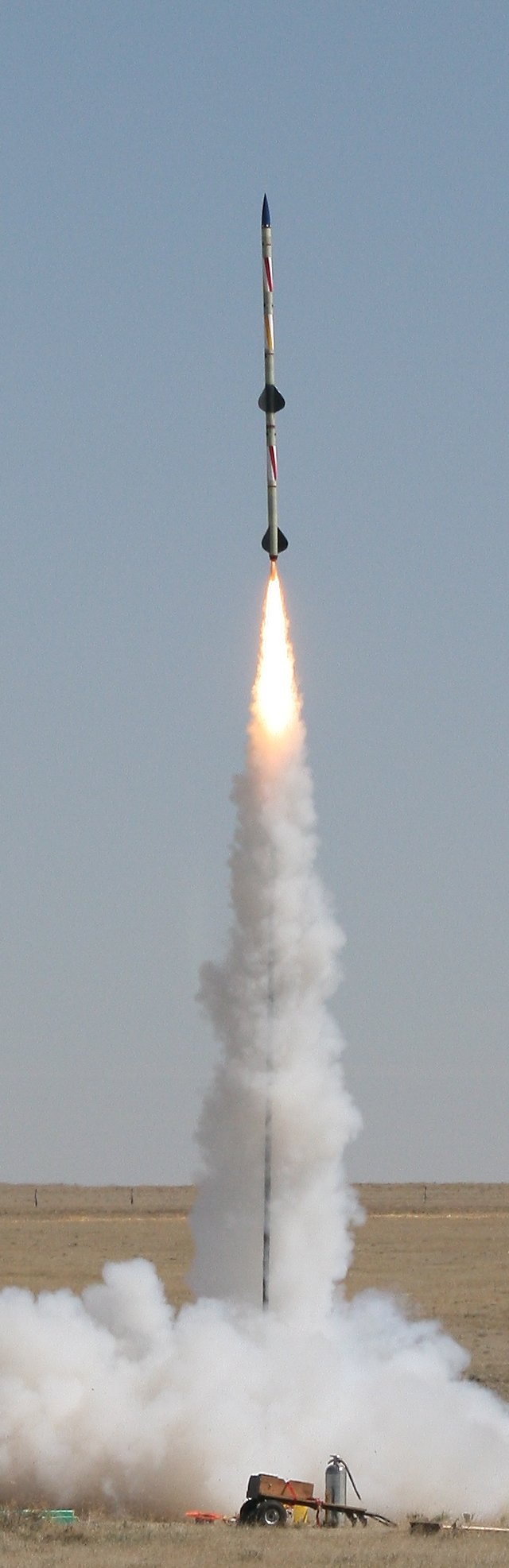
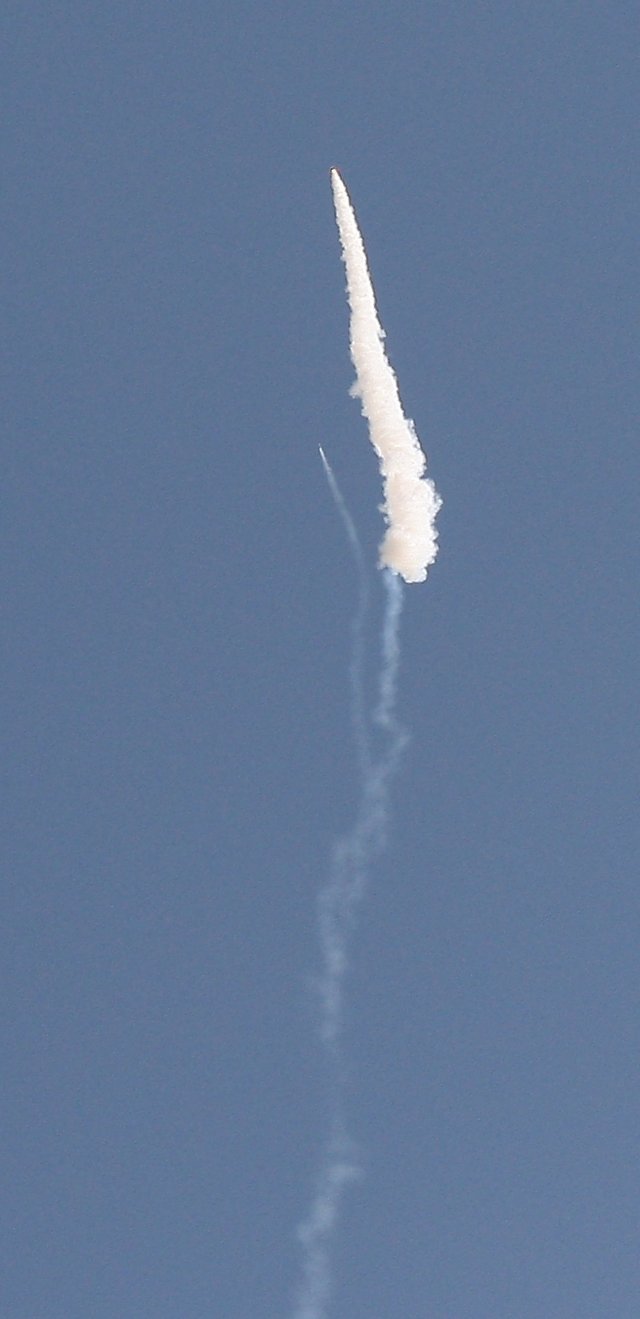
The Launch of The Twins
The ignition of the sustainer, Micky. The booster, Ricky, seen coasting to its apogee
Pictures courtesy of Bert Harless
2008-05-06 at 9:34 pm #47836Chris LaPanse
Looking at some of my dad’s shots, it’s hard to tell, but it’s possible that it came off as a drag separation right after booster burnout. It looks like it gets shorter at that point, but it’s hard to tell for sure, as the rocket is quite far away at that point.
2008-05-06 at 9:40 pm #47837slipstick
Looking at some of my dad’s shots, it’s hard to tell, but it’s possible that it came off as a drag separation right after booster burnout. It looks like it gets shorter at that point, but it’s hard to tell for sure, as the rocket is quite far away at that point.
I’d like to see a smoke trail of what happened after 2nd stage burn-out. Can you ask him to send them to me please? Thanks Chris
2008-05-06 at 9:54 pm #47838Chris LaPanse
Sure. I’ll tell him to contact you.
2008-05-07 at 2:03 am #47839elviss_boy
One thing that I would suggest from your design is on your booster you separate it in the middle of the tube. I would suggest ejecting your chute out the top only because when you make that extra break in the rocket you have more chances of the rocket shaking and possible folding from the forces. And folding at the joints happens often on two stages because of the length. If you want you could talk to my dad Eric Parsons, he successfully did a two stage a few years back.
2008-05-07 at 4:29 pm #47840slipstick
… And folding at the joints happens often on two stages because of the length.
That was a major design consideration. Thanks for bringing it up. In order to improve the longitudinal stability, the coupler/airframe interfaces in the middle of the rocket all had a 1-1/2 diameter (4-1/2″) overlap vs the normal one diameter (3″) overlap. It was a fairly rigid rocket when carried in its all-together.
2008-05-07 at 9:11 pm #47841slipstick
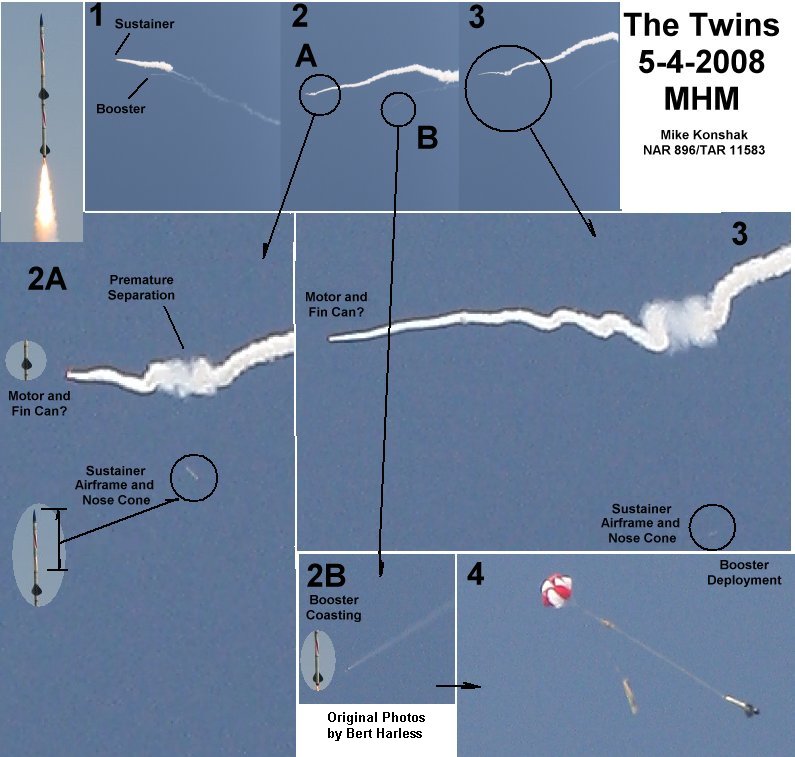
Bert sent me some high resolution pictures whiuch I was able to zoom in on and get some revealing information, Thanks Bert! It appears the boost section of the sustainer was aerodynamic for a while after it came apart from the rest of the sustainer. Now I know why the altimeter(s) read so low.
2008-05-07 at 10:13 pm #47842AdrianParticipantAwesome photo analysis. Very interesting. So I guess it boils down to: Why did the sustainer separate prematurely?
The separation happened with the sustainer under thrust, so drag separation should be ruled out.
Could a lack of venting cause enough pressure to overcome the motor thrust and the shear pins? It seems unlikely but a quick calculation could help answer that one.
A premature firing of the charge remains a possibility. Could you tell anything about whether the charge fired while the pieces were together by the post-flight condition of the upper part of the sustainer?
Some recorded data would really go a long way here.
2008-05-07 at 10:35 pm #47843Dreasher
Well this explains what I saw when I thought I saw a fin had shredded off. It wasn’t the fin the sustainer BT and NC falling off. I hope your able to find all the part so you can figure out what happen before round two flies.
Ron
-
AuthorPosts
 slipstick
 Chris LaPanse
 elviss_boy
 Adrian
 Dreasher
- You must be logged in to reply to this topic.